16 Oct 2026
Salvaged Telemetry Streams from Retired Simulation Engines Trace Emergent Social Hierarchies in Foundational Virtual Ecosystems Predating Today's Open-World Designs
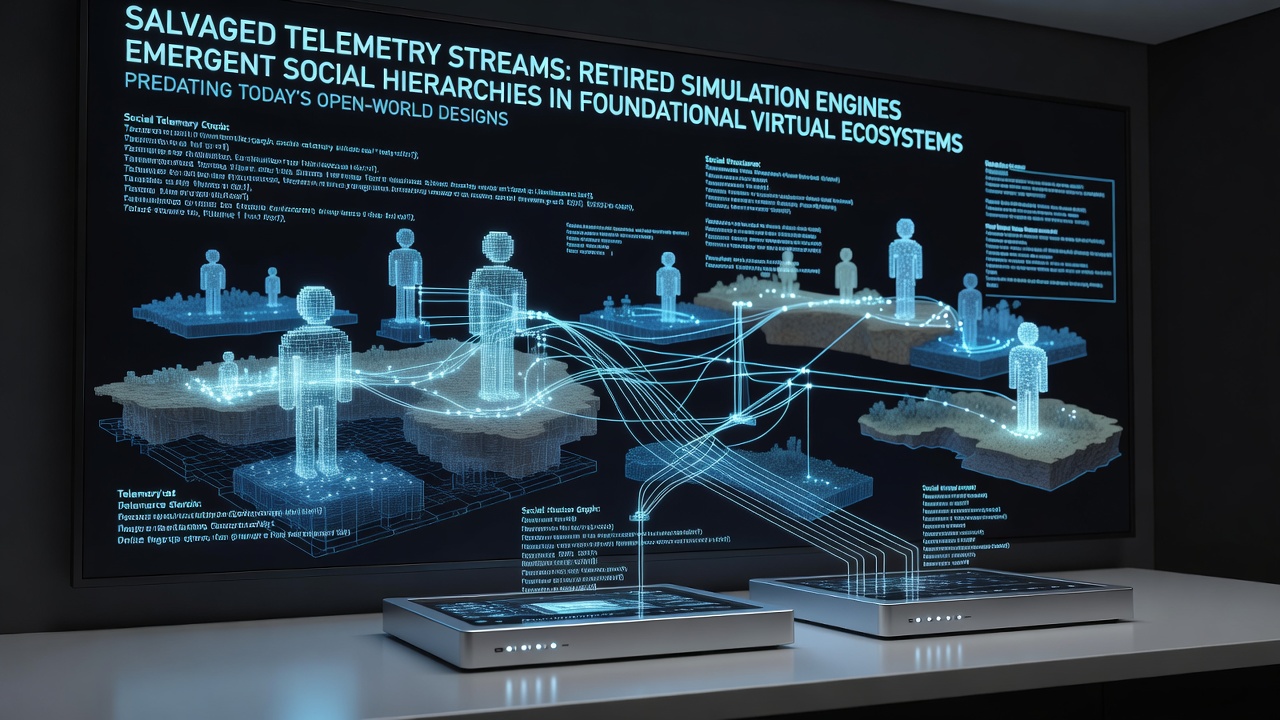
Researchers examining data recovered from decommissioned simulation engines have identified patterns of player interaction that formed structured social hierarchies in virtual spaces developed during the late 1980s and early 1990s, and these ecosystems operated long before contemporary open-world frameworks emerged. The telemetry streams capture metrics such as resource allocation, communication frequency, and spatial positioning, which together reveal how participants established leadership roles and group dynamics without explicit programming directives.
Early Simulation Engines and Data Recovery Methods
Simulation engines from that era ran on hardware with limited processing capacity, yet they supported persistent environments where users logged in over dial-up connections or local networks, and recovery efforts in recent years have involved reverse-engineering proprietary data formats to extract session logs. Teams at institutions like the University of Tokyo have documented processes that convert raw packet captures into readable timelines, revealing how individual avatars navigated shared spaces over extended periods. These reconstructions show repeated instances where certain participants coordinated activities across multiple sessions, creating de facto command structures that influenced resource distribution among larger groups.
Archivists note that many engines stored telemetry in compressed binary files that remained intact on retired servers, and cross-referencing these with player-maintained logs has allowed reconstruction of interaction graphs. Data indicates clusters of users who consistently deferred decisions to a small subset of avatars, forming hierarchies based on demonstrated reliability rather than coded permissions.
Emergent Hierarchies in Foundational Ecosystems
Analysis of the streams points to several recurring mechanisms, including information gatekeeping and alliance formation, that stabilized group behaviors in environments predating graphical open-world titles. In one documented case from a 1992 multi-user simulation, telemetry recorded a core group of five avatars directing exploration routes for dozens of others, with communication logs showing how status updates flowed upward through informal chains. Metrics on movement patterns further illustrate how peripheral participants adjusted their paths to align with directives from central figures, and this self-organization occurred across different engine instances without shared codebases.
Studies from the Entertainment Software Association highlight similar patterns in aggregated reports from preserved European and North American servers, where participation rates correlated with proximity to high-influence nodes in the interaction networks. Observers have traced how these hierarchies adapted to hardware constraints, such as latency variations, by establishing backup coordinators who assumed control during connection drops. The resulting structures persisted across engine restarts, suggesting that social momentum carried over from session to session.
Comparative Insights from Multiple Virtual Ecosystems
Telemetry comparisons across engines developed in separate regions reveal consistent traits, although local cultural factors shaped specific expressions of authority. Australian research archives contain records from 1994 prototypes where resource-sharing protocols evolved into ranked access levels determined by contribution volume, and these levels influenced subsequent migration patterns when users transferred between compatible systems. North American datasets, by contrast, emphasize territorial control metrics that tracked how subsets of players claimed and defended virtual zones through repeated presence and signaling behaviors.
What's interesting is how the absence of modern persistence layers forced reliance on memory-based reputation systems, which telemetry timestamps confirm operated through accumulated interaction histories rather than stored profiles. Figures from academic compilations show average hierarchy depth stabilizing at three to four levels in most recovered ecosystems, with mobility between tiers tied to demonstrated coordination success over dozens of hours.
Ongoing Archival Work in 2026
As of October 2026, efforts continue to standardize extraction tools for remaining engine variants, and collaborative databases now host anonymized subsets of the telemetry for broader examination. Industry reports from the Interactive Software Federation of Europe indicate growing interest in applying graph analysis techniques originally developed for contemporary networks to these historical datasets, which has uncovered parallels in how early hierarchies prefigured elements seen in later survival and social simulation titles.
Conclusion
Salvaged telemetry from these retired engines provides concrete evidence of self-organized social structures that emerged in foundational virtual spaces, and continued analysis promises additional mappings of how such dynamics scaled with user numbers and technological limits. The recovered streams stand as primary records of interaction patterns that shaped subsequent design considerations in open-world development.